A SASSA grant overpayment is money paid to someone who was not entitled to it, and the law says it is owed back to the State. You are not without options. Check the months and the amount, and ask for remission if you truly did not know you were not entitled.
Contents (13 topics)
- Have you received a message saying you owe money?
- What counts as an overpayment?
- What does the law say about repayment?
- Which situation looks like yours?
- How do you respond to an overpayment notice?
- Can you ask SASSA to reconsider the decision?
- Should you agree to pay in instalments?
- Can SASSA take it out of your next grant?
- What happens to your grant from now on?
- How can you avoid a new overpayment?
- Tips for handling a repayment claim
- Frequently Asked Questions
- Your best next step
Have you received a message saying you owe money?
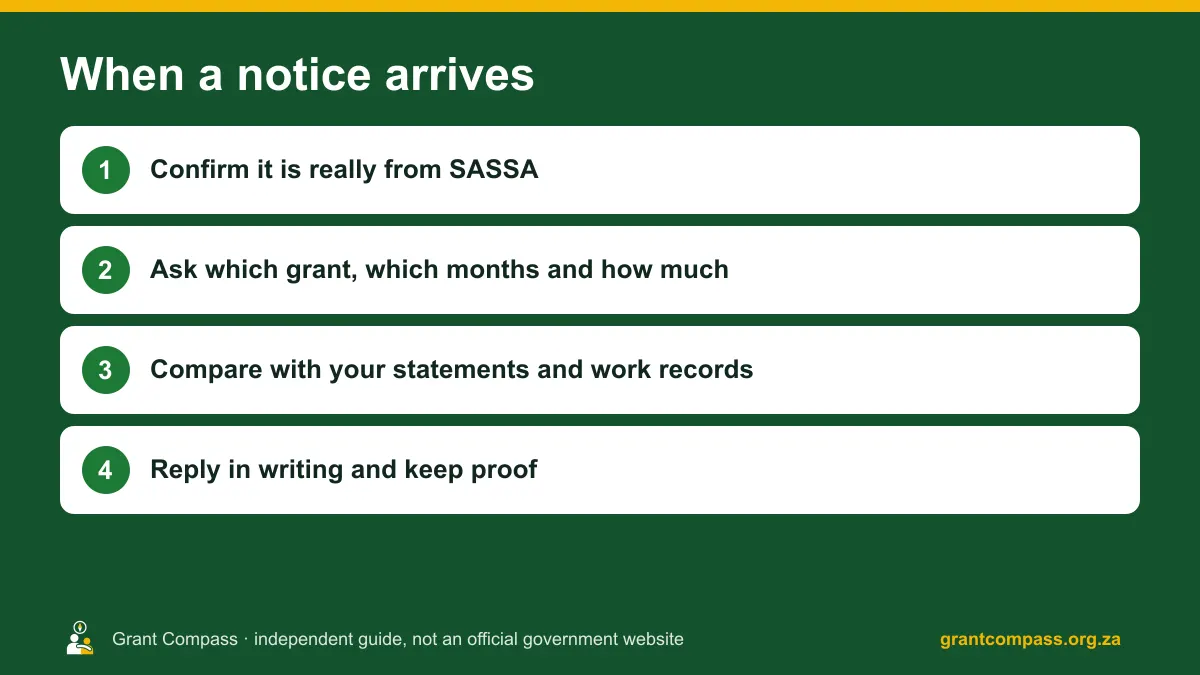
First make sure the message is real, because scammers use debt threats to frighten people. Do not pay, click a link or share details until you have checked.
Phone SASSA on 0800 60 10 11 or visit an office with the notice. Ask whether a debt is recorded against your name. Use only contact details you found yourself, not those printed in a suspicious SMS.
Warning: SASSA says it will never ask for your bank PIN. Anyone who offers to cancel a debt for a fee is not to be trusted.
What counts as an overpayment?
It is any grant money SASSA paid believing you were entitled to it, when you were not. That includes whole payments and amounts higher than you should have received.
These events often sit behind a claim:
- You started a job or your income rose past the limit.
- You married and your joint income changed.
- A child left your care but payments continued.
- Someone died and money was still paid.
- You were outside South Africa for more than 90 days without approval.
- The grant was approved in error, or information was wrong.
A review does not mean you owe anything. It is a check. See how to Prepare for a grant review.
What does the law say about repayment?
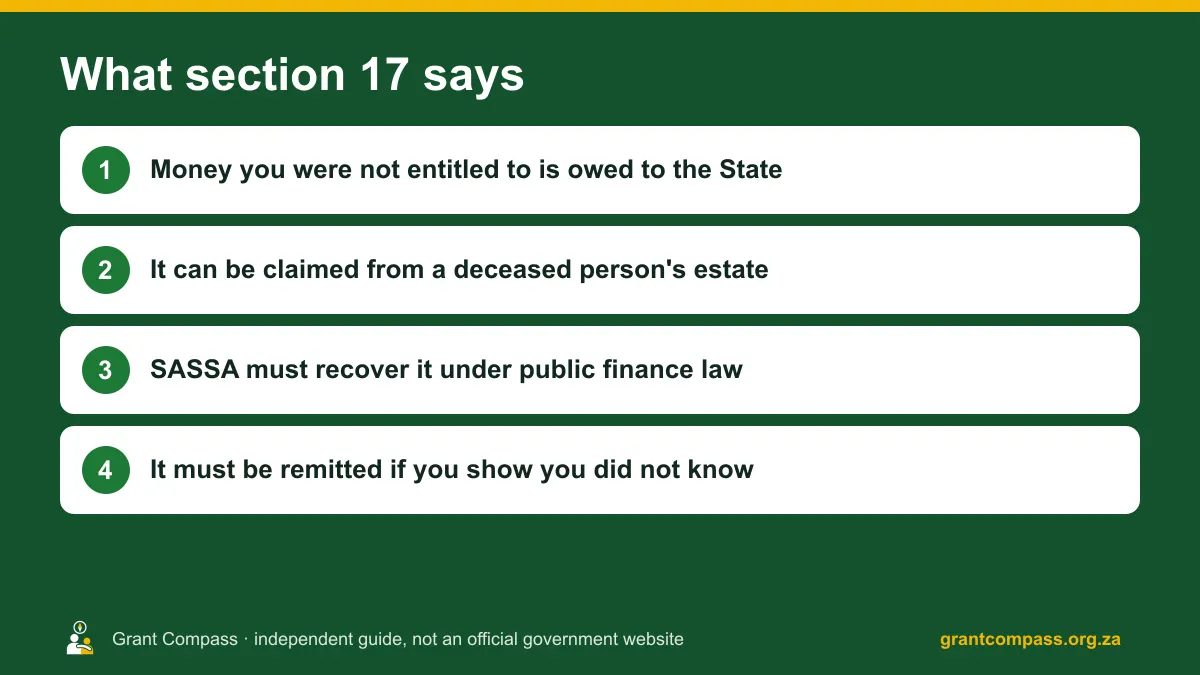
Section 17 of the Social Assistance Act says the amount is due and payable to the State. SASSA must recover it in line with the Public Finance Management Act. If the person has died, the claim can be made against the estate.
The same section protects some people. The Minister must remit an amount, meaning let it go, if you satisfy the Minister that you received it without knowing you were not entitled to it.
The key words are "without knowing" and "satisfies". You have to show your situation with facts. The protection is not automatic.
When is it more serious than a debt?
It is an offence to receive social assistance knowing you are not entitled to it, or not to the full amount, and to stay silent. False or misleading information is also an offence. If you face such an accusation, get legal advice before making statements.
Which situation looks like yours?
Your facts shape your response. The table gives a starting point and cannot predict the outcome.
| Your situation | Question to answer | Useful proof |
|---|---|---|
| You reported the change but payments continued | When and where did you report? | Receipt, reference number, email |
| You did not realise the change mattered | What were you told, and what did you understand? | Application papers, notices |
| The amount or months look wrong | Which payments did you qualify for? | Bank statements, payslips |
| You never received the money | Where was it paid? | Your account records, SASSA payment history |
| A relative's grant was paid after death | Who accessed the account? | Death certificate, bank records |
If money was taken by someone else, say so early. Our guide on a Procurator keeping money may apply.
How do you respond to an overpayment notice?
Reply in writing, ask for the calculation and keep proof that you did. Silence does not make a debt go away.
- Read the notice. Note the date you received it and any deadline.
- Ask for details. Request the grant type, months, amount, reason and how the figure was worked out.
- Check your records. Match each month with statements and payslips.
- Mark disputes. Circle months when you did qualify or never received money.
- Write your explanation. Give dates and attach copies.
- Ask for remission if it fits. Refer to section 17(3) of the Act.
- Hand it in. Get a stamp or reference number.
- Follow up. Ask what happens to recovery while your request is considered.
What can you write to ask for remission?
Keep it plain. State your name and grant type, then say: "I received this money without knowing that I was not entitled to it. I ask that the amount be remitted under section 17(3) of the Social Assistance Act."
Then explain when your circumstances changed, what you understood and what you reported. This wording is our example, not a SASSA form. Ask the office whether it has its own process.
Can you ask SASSA to reconsider the decision?
Yes, a person who disagrees with an agency decision under the Act may ask SASSA to reconsider it within 90 days of learning about it. If you disagree with the reconsidered decision, you have another 90 days to appeal.
The reconsideration request goes to the agency in the prescribed way. Ask an official to help you lodge it. SASSA's 2026 booklet gives [email protected] for appeals on normal grants. SRD matters use a separate route, explained in our SRD appeal guide.
Should you agree to pay in instalments?
Only sign after you accept the amount or understand what you are giving up. A signed acknowledgement of debt can make it harder to dispute the figure later.
If the debt is correct and you cannot pay at once, ask whether instalments are possible. Ask for the monthly amount, the end date, any interest and the official payment reference in writing. Terms can differ, so do not rely on what another person was offered.
Can SASSA take it out of your next grant?
Do not assume either way. The Act protects your right to receive the full grant, apart from deductions the rules permit. Ask SASSA to state in writing how it intends to recover the amount.
If your payment is smaller than usual and you have received no explanation, check for other causes. Our page on Money missing from your grant covers funeral policies and debit orders.
What happens to your grant from now on?
An old debt and your current eligibility are separate questions. SASSA may find that you still qualify, qualify for less or no longer qualify.
When a financial change lowers a grant, the new amount applies from the month after the change. You have a 30-day period to ask for a review of that decrease. For a planned suspension or cancellation, SASSA must usually give 30 days' notice and let you respond. Fraud cases differ. If payment has already stopped, see How to restore a grant.
How can you avoid a new overpayment?
Report changes when they happen and check that they were captured. The Act asks you to inform SASSA as soon as reasonably possible after a material change.
Our guide to Changes you must report lists them. If you no longer qualify, ask SASSA to cancel the grant and keep proof of the request. SRD applicants can read about Income and money checks.
Tips for handling a repayment claim
- Do not ignore it. A late reply can leave you with fewer options.
- Ask for the maths. A total without months cannot be checked.
- Get statements early. Banks can print older months if you ask.
- Write, then speak. Put your main points on paper before the visit.
- Be truthful. A wrong date or story can damage an otherwise good request.
- Bring a helper. Someone you trust can take notes while you talk.
- Seek free advice. Legal Aid South Africa or a local advice office may be able to assist.
- Pay only officially. Confirm payment details with SASSA in person before sending money.
Frequently Asked Questions
Must I repay a SASSA grant overpayment?
Generally yes. Money you were not entitled to is due to the State under section 17. The main exception in that section is remission where you satisfy the Minister that you received it without knowing you were not entitled. You can also dispute wrong months, amounts or reasons.
What if I did not know I no longer qualified?
Ask in writing for remission under section 17(3). Explain what you knew, when your situation changed and why you did not realise it mattered. Attach proof. The Minister must remit the amount if satisfied, but you carry the task of showing that your account is true.
Can SASSA claim money after someone dies?
Yes. The Act says an overpaid amount can be owed by the person's estate. This may happen when payments continued after a death. Report the death promptly, do not use the card, and ask SASSA which months it says were not due before the estate is wound up.
Can I go to jail for an overpayment?
A debt on its own is different from an offence. The Act does make it an offence to receive money knowing you are not entitled to it without informing SASSA, or to give false information. If anyone alleges fraud, speak to a lawyer before you sign or explain further.
How long do I have to challenge the decision?
You have 90 days from learning of an agency decision to ask SASSA to reconsider it. After you learn of the reconsidered decision, there are a further 90 days to appeal. Your notice may mention other dates, such as 30-day periods, so act as early as you can.
Will my grant stop because I owe money?
Owing money does not by itself answer whether you still qualify. SASSA checks eligibility against the rules for your grant type. If it plans to suspend or cancel, it must usually give notice, reasons and a chance to respond. Ask directly what the notice means for future payments.
Is a smaller payment always an overpayment recovery?
No. A smaller amount can result from a funeral policy deduction, a bank debit order, a fee, or a change to your grant amount. Check your bank statement and ask SASSA what it paid. Do not accept a verbal guess about why money is missing.
Can I stop a grant I no longer qualify for?
Yes. Tell SASSA at an office or ask on 0800 60 10 11 how to request cancellation. Take your ID and proof of the change. Keep the receipt. Cancelling stops new payments building up, but it does not by itself settle an amount already overpaid.
Does the rule apply to SRD money?
The recovery section covers money SASSA paid in the belief that someone was entitled to it under the Act, which includes social relief of distress. If you receive a notice about SRD, ask which months are involved and check them against your own SRD status history and bank records.
Where should I send my explanation?
Hand it to a SASSA office and get a date stamp, or ask which official address to use. General enquiries go to [email protected]. Name the notice reference in the subject line. Never include your bank PIN, and send copies instead of your only originals.
Your best next step
Visit SASSA with the notice and ask for a month-by-month breakdown before you agree to anything. Then put your reply in writing, including a remission request if it fits. Our Contact guide shows other ways to reach the agency.
Sources
- Social Assistance Act 13 of 2004
- Social Assistance Amendment Act 5 of 2010
- Social Assistance Regulations, 2022 (Government Gazette 46459)
- SASSA grant booklet 2026 (You and Your Grant)
- SASSA services portal: contact us

About The Author
Michael Williams is an informational content writer focused on South African social grants, SASSA services and public assistance information.
Keep Reading