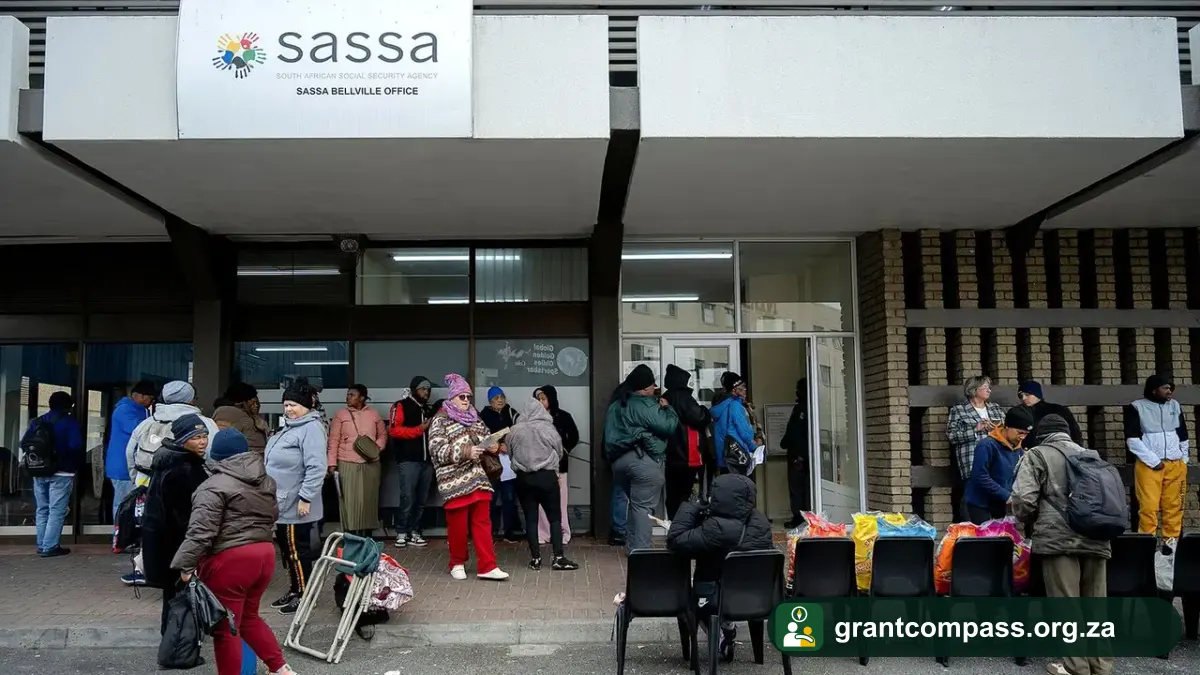
A SASSA grant review is a check that you still qualify for your grant. If you receive a notice, you normally need to visit a SASSA office with your documents within the time given. Do not ignore it. SASSA has not confirmed a general way to complete the whole review online.
Contents (16 topics)
- What does your message ask you to do?
- What is a SASSA grant review?
- How will SASSA tell you?
- Can you do a SASSA grant review online?
- Which documents should you take?
- What extra papers apply to your grant?
- What if you are missing a document?
- How should you prepare for your own situation?
- What happens at the office?
- What if you cannot attend?
- What happens to your payment during a review?
- What can happen after the review?
- How can you avoid trouble at the next review?
- Tips for an easier review day
- Frequently Asked Questions
- Your next step
What does your message ask you to do?
Start with the exact words of your SMS or letter, because they decide your next move. Match your message to a line below.
| If your message or situation says | Do this | Do not do this |
|---|---|---|
| Visit an office for a review | Gather documents and go in time | Wait for a second SMS |
| Bring specific papers | Take those, plus your ID | Assume a general list is enough |
| Submit a life certificate | Complete proof of life | Treat it as the full review |
| You cannot travel because you are ill | Phone the office and ask about a procurator | Stay silent |
| Pay a fee or click a strange link | Stop and verify | Send money, a PIN or a code |
| You see nothing but payment is late | Check your review status | Assume the grant is cancelled |

What is a SASSA grant review?
It is SASSA's way of updating your details and confirming that you still meet the rules. The 2026 SASSA booklet describes it as a check on personal details and eligibility.
Reviews apply to social grants such as the Older Persons, Disability, War Veterans, Child Support, Foster Child and Care Dependency grants. A review does not mean you did something wrong. It also does not guarantee that your grant will stay the same.
Why might you be picked?
The regulations say SASSA must review a grant at any time when it has reason to believe your financial circumstances may have changed. Some reviews have other triggers:
- a foster care court order that expires
- a refugee's identity document that expires
- reason to believe a child's disability is no longer permanent
You may also be reviewed for reasons SASSA does not spell out in your SMS. Ask at the office if you want to know why.
Is a review the same as an SRD appeal?
No. A review checks an existing social grant. An SRD appeal challenges a declined R370 month and is started by you. If your SRD month was declined, use our guide to Lodging an appeal instead.
How will SASSA tell you?
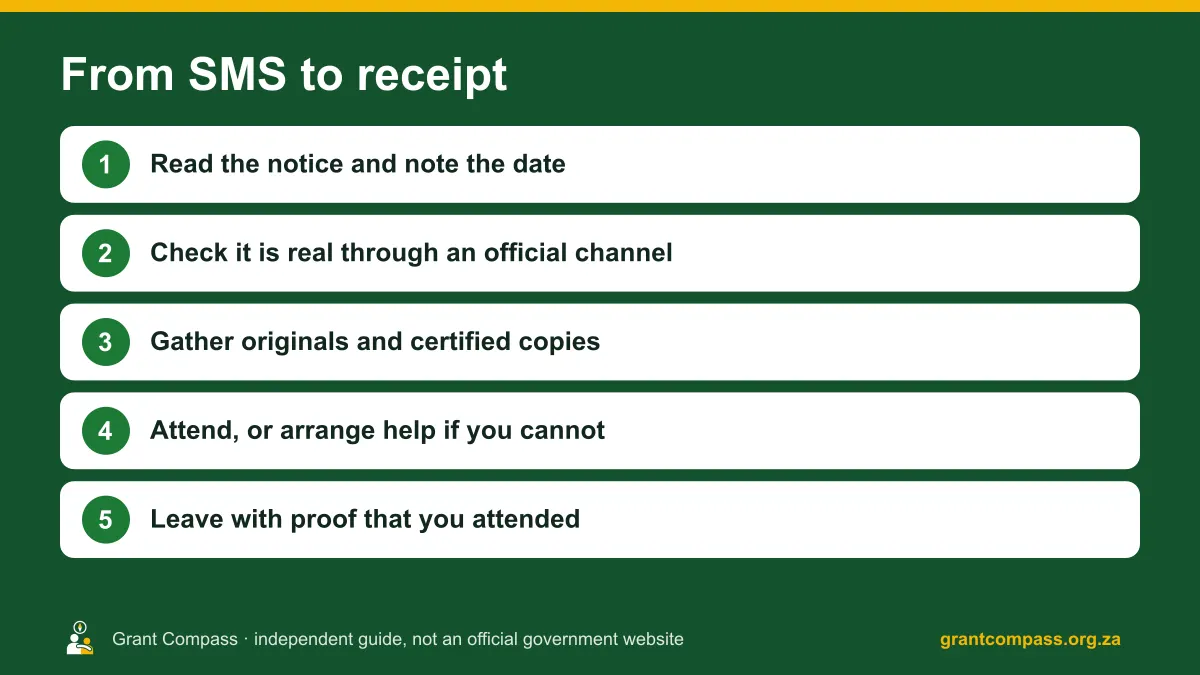
SASSA sends review notices by SMS to the cellphone number on its database. A July 2026 government statement stresses that it can only use the contact details it has.
The regulations say SASSA must inform you of a review date 30 days ahead, by electronic or other communication. In March 2026 SASSA also urged beneficiaries to respond to a 30-day notice to visit its offices.
If you changed your number, a notice could reach your old SIM. Update it before it becomes a problem. Keep your postal and home address current too.
How do you know the SMS is real?
Check it through a channel you already trust. Call SASSA on 0800 60 10 11, visit your local office or use the review check on WhatsApp. Our guide to Checking where your grant review stands shows how.
Warning: SASSA will never ask for your PIN. Do not share a one-time code, bank password or card with anyone who phones or messages about a review.
Can you do a SASSA grant review online?
Do not count on completing it online. In February 2026 SASSA said reviews were being done at designated offices and service centres, and that online options might come later.
A reply to Parliament the same month said SASSA was developing a self-service electronic review channel. Once finished, it should be available on the SASSA Services Portal. We found no official announcement that it is live.
| Task | Can you do it from home? |
|---|---|
| Check whether you are flagged for review | Yes, reported on SASSA's WhatsApp line |
| Ask a question about your notice | Yes, by phone or email |
| Update every review document and finish | Not confirmed |
| Complete proof of life | Depends on the method SASSA offers you |
| Appeal a declined SRD month | Yes, on the official appeal portal |
If your notice names a specific online method, and you can confirm it is official, follow it. Otherwise plan to attend. You can read what the portal currently covers on our SASSA online services page.
Which documents should you take?
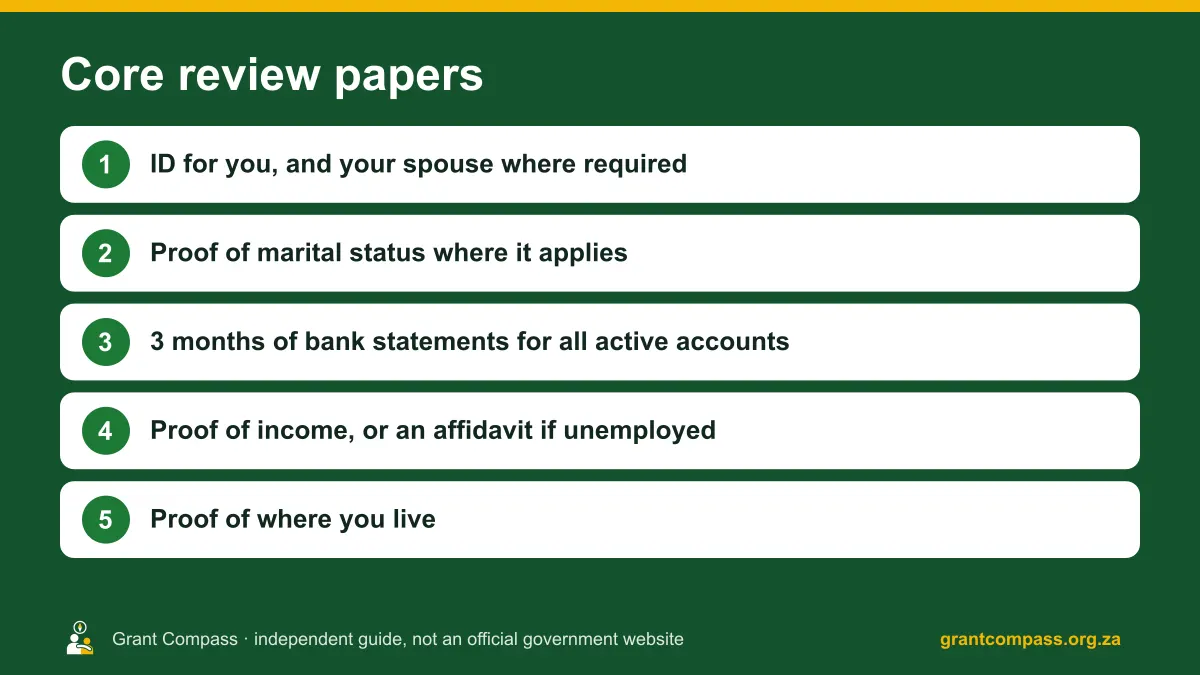
Take your ID, proof of your money situation, proof of address and the papers linked to your grant. Add everything your notice lists.
A July 2026 government statement gives this list for beneficiaries under review:
- Your 13-digit barcoded ID or smart ID card, and your spouse's ID if required.
- Proof of income, such as payslips or pension slips, or an affidavit if you are unemployed.
- Bank statements for the last three months for all active accounts.
- Proof of residence, such as a municipal account, utility bill or a letter from a traditional authority or ward councillor.
- Proof of marital status where it applies.
- Grant-specific papers.
- Any extra documents named in your notice.
Bring original documents together with certified copies where required.
What does the SASSA booklet add?
The 2026 booklet asks for certified ID copies for you and your spouse, and your previous ID number if you were issued a new one. It also lists statements for fixed deposits and investment accounts.
It mentions proof of employment and earnings, including start or end dates. It also asks for proof of any other income, and a rates and taxes certificate for property you own but do not live in.
What counts as proof of marital status?
Use the document that matches your life today. It could be a marriage certificate, a divorce order or your spouse's death certificate. Where there is separation or desertion, the statement mentions an affidavit.
What extra papers apply to your grant?
Each grant has its own proof. The table shows what to think about before you pack.
| Grant | Papers to consider |
|---|---|
| Child Support | The child's birth certificate and school attendance proof |
| Foster Child | A valid court order or extension order, and school proof |
| Care Dependency | The child's birth certificate and medical papers if asked |
| Disability | A medical referral report if asked |
| Older Persons and War Veterans | Income, pension slips, assets and marital proof |
Do you need a medical report?
You might for a disability or care dependency grant. A 2025 government news report on reviews mentions a medical referral report where it applies. Ask your office before you pay for any new report.
Do you need school proof for a child grant?
Take it if your child is of school-going age. The 2026 booklet says failing to attend school or to submit proof will not get a child grant application refused. A review may still ask about attendance, so bring what the school can give you.
What if you are missing a document?
Do not skip the review because one paper is missing. Go in time, explain, and ask what can replace it.
- Check whether your notice really asks for that paper.
- Phone 0800 60 10 11 and ask what SASSA accepts instead.
- Start the replacement, such as a birth certificate at Home Affairs.
- Attend with everything else you have.
- Ask the official to note what is outstanding and by when you must hand it in.
- Write down the official's name and the date.
What if you have no bank statement?
Ask your bank branch for a printed, stamped statement. If an account is closed or you cannot get history, ask the bank for a letter and show it to SASSA. Do not leave an active account out.
What if you have no proof of address?
A letter from a ward councillor or traditional authority is named as an option. The booklet also mentions a letter from a landlord or chief.
How should you prepare for your own situation?
Think about what has changed since you applied, then pack the paper that shows it. These common situations can help you plan.
If you lost your job
Take proof of when the job ended. A news statement on reviews mentions an affidavit or employment discharge confirmation for people who are no longer employed. Bring your latest payslip too if you still have it.
If you started working or earning
Declare it, even if the work is part-time or irregular. Take payslips, or an affidavit that explains what you earn and how often. Hiding income can lead to a worse outcome than reporting it, because SASSA may check with banks and other institutions.
If you married, separated or lost your spouse
Take the document that shows the change. Your spouse's income can count in a means test, so bring their papers where you are still married. If your spouse has died, take the death certificate.
If you moved house
Take a recent proof of the new address and ask the official to update your record. Check your cellphone number at the same visit. If you moved to another area, ask which office should handle your file.
If money from family passes through your account
Be ready to explain deposits that are not wages. Write a short list with dates, amounts and what each was for. Ask the official whether SASSA wants an affidavit. Do not guess how a deposit will be treated.
If the child has moved or someone else cares for them
Say so at once. A child grant follows the primary caregiver, so the record may need to change. Do not keep claiming for a child who no longer lives in your care. Bring any court order or social worker letter you have.
What happens at the office?
Expect an official to compare your documents with your record and ask about changes in your life. Answer truthfully, even if you think a change could reduce your grant.
- Arrive early with your papers in order.
- Say you are there for a review and show the SMS.
- Hand over originals and copies when asked.
- Declare income, work, marriage, death in the family, or a move.
- Check any form before you sign it.
- Ask for written proof that you attended.
- Ask when you will hear the outcome.
Take water, your regular medicine and your phone. If you need to find your nearest branch, start with our SASSA office guide.
What proof should you leave with?
Ask for a receipt, acknowledgement or reference number. Take a photo of it. Without proof, it is hard to show later that you did your part.
What if you cannot attend?
Contact your nearest SASSA office before the date passes. A July 2026 statement says people who are bedridden or medically unable to visit can appoint an authorised procurator where applicable.
A procurator must be formally appointed. A neighbour with your ID is not enough. See Who can act as your procurator.
If the problem is transport or money rather than health, still phone. Ask about outreach points or another date. Do not assume an extension was granted unless SASSA says so.
What happens to your payment during a review?
Your payment may be moved to a later day, and you may need to visit an office afterwards. For August 2026, SASSA paid grants under review on a fourth payment day, 7 August, and asked those people to visit during August.
That was a specific monthly notice. Do not assume it works the same every month. Check the notice for the current month and our SASSA payment dates page.
What if you ignore the notice?
Your grant can be suspended or can lapse. SASSA has repeated this warning in 2026. A parliamentary reply says that if a suspended beneficiary then completes the review and still qualifies, the suspension is lifted and the missed period is paid. Do not rely on that as a plan. Read How to get a stopped grant back.
What can happen after the review?
Your grant may continue, change in amount, or stop if you no longer qualify. SASSA must tell you about a decrease or a planned stop.
The regulations give you rights here:
- If your grant is decreased after a change you reported, you must be told why, with a 30-day period to ask for a review of that decision.
- Before suspending or cancelling in most cases, SASSA must give 30 days' notice with reasons.
- That notice must explain your right to make representations and how to appeal.
Fraud or misrepresentation is treated differently. If you disagree, ask for the reasons in writing and act quickly. SASSA's booklet gives [email protected] for appeals on social grants, and says an official can help you lodge one.
How can you avoid trouble at the next review?
Tell SASSA about changes when they happen, not only when you are called. Your booklet duty includes reporting changes in income, marital status, address, contact details and child care arrangements.
If you will be outside South Africa for more than 90 days, tell SASSA before you leave. Our page on Changes to report lists the common ones. If you are unsure how income affects a grant, read about the Means test.
Tips for an easier review day
- Read the notice twice. Circle the date and any paper it names.
- Use one folder. Keep originals in front and copies behind.
- Start with bank statements. All active accounts means every one, even the quiet ones.
- Certify copies early. A police station is a common place to do it.
- List your changes. Write them down so you forget nothing at the desk.
- Charge your phone. You may need to show the SMS.
- Keep your originals. Ask for them back before you leave the desk.
- Refuse paid shortcuts. A review at SASSA costs nothing.
- Ask in your own language. Request help if the form is unclear.
- Follow up politely. Quote your reference and visit date.
Frequently Asked Questions
How much time do I get to respond?
Use the date on your notice. The regulations say SASSA must inform you of a review date 30 days ahead, and SASSA has spoken about 30-day notices. Do not count days from when you happened to read the SMS. If you cannot work out the deadline, phone 0800 60 10 11 or visit your office straight away.
Can someone else take my documents in for me?
Only a properly appointed procurator may act for you. SASSA mentions this for people who are bedridden or medically unable to visit. A relative who simply carries your papers may be turned away. Phone your local office first, ask what it needs, and sort out the appointment before the deadline.
Do I need bank statements if my account is empty?
Yes, include it if the account is active. The July 2026 statement asks for three months of statements for all active accounts. A low or zero balance is still information. Leaving an account out can look like you are hiding it, and SASSA may ask you to return with the missing statement.
Is the review free?
Yes, you should not pay SASSA or any agent to be reviewed. You may spend money on transport, copies or bank statements. Anyone who asks for a fee to approve your review, move you up the queue or remove a flag is a risk. Report them to SASSA or the police.
Does a review mean my grant is cancelled?
No. A review is a check, and many outcomes are possible. Your grant could continue unchanged, be adjusted or be stopped if you no longer qualify. Cancellation or suspension is a separate decision. In most cases you should receive notice with reasons and a chance to respond before that happens.
I never got an SMS. Could I still be under review?
Yes, it is possible, especially if your number changed. If a payment is late or you hear of a review, check on SASSA's WhatsApp line, phone the call centre or ask at your office. Also confirm which cellphone number is on your record so that later messages reach you.
Can I finish my review on WhatsApp?
We found nothing saying you can. News reports say the WhatsApp line tells you whether a review or proof of life is required and gives next steps. That is a status check. If your notice asks you to visit an office with documents, do that, and keep the proof you receive there.
Do SRD beneficiaries get this kind of review?
The SRD grant is assessed month by month through its own online process. Statuses and appeals work differently from reviews of social grants. If your SRD status asks for identity verification or shows a decline, follow the SRD instructions. Do not take review documents to an office only because your R370 month was declined.
What if my spouse refuses to give me documents?
Tell the official exactly what the problem is. Take your marriage certificate and any other proof you have of the situation. Where you are separated or deserted, SASSA's lists mention an affidavit. Ask what wording is acceptable and whether more evidence is needed, rather than leaving the spouse out silently.
What should I do after submitting everything?
Keep your receipt, note the date and watch for messages. Check your review status after a while and look at your next payment. If SASSA asks for more, send it quickly. If you hear nothing and a payment stops, return with your proof of attendance and ask what is outstanding.
Your next step
Open your notice, write the deadline on paper and put your ID and three months of statements in one folder today. If your health makes travel impossible, phone 0800 60 10 11 first and ask about a procurator.
Sources
- SASSA reminds beneficiaries identified for review to expect payment on the fourth payment day, gov.za
- SASSA urges beneficiaries to respond to 30-day notice for grant reviews, SAnews
- SASSA urges beneficiaries not to ignore SMS notifications for social grant reviews, SAnews
- You and Your Grant 2026 (SASSA booklet)
- Social Assistance Act Regulations, Government Gazette 46459
- Parliamentary question NW209 on suspended grants, PMG

About The Author
Michael Williams is an informational content writer focused on South African social grants, SASSA services and public assistance information.
Keep Reading