A SASSA procurator is an adult you formally appoint, by power of attorney, to apply for or receive your grant when you cannot do it yourself. SASSA must have the paperwork before anyone acts for you. One procurator may not receive social assistance for more than five beneficiaries.

Contents (19 topics)
- Which situation sounds like yours?
- What is a SASSA procurator?
- When may you appoint one?
- Who can be your procurator?
- What is the five-person limit?
- Which documents do you need?
- How do you appoint a procurator?
- What if you only need help for a few months?
- What may a procurator do?
- Do you need a procurator for a grant review?
- Can a procurator handle the SRD grant?
- How do you change or cancel a procurator?
- What if the procurator keeps your money?
- What happens if the beneficiary dies?
- What if SASSA refuses the appointment?
- Are there other ways to get your money?
- Tips for a safe arrangement
- Frequently Asked Questions
- Your next step
Which situation sounds like yours?
Start with why you need help, because not every problem needs a procurator.
| Your situation | What fits | First step |
|---|---|---|
| Too frail, ill or disabled to apply or collect | Procurator | Ask SASSA for the power of attorney form |
| Sick for a short while | Temporary authorisation may fit | Ask SASSA about up to three months |
| Cannot get to the bank today only | Often no SASSA step | Wait, or use your own banking options |
| Cannot appoint anyone because of your condition | SASSA may nominate someone | Family should speak to SASSA |
| Someone is already misusing your money | End or investigate the arrangement | Report to SASSA at once |
| You care for a child and get the child grant | You are the caregiver, not a procurator | Keep your own record up to date |

What is a SASSA procurator?
A procurator is a person who acts for you with SASSA. The Social Assistance Act lets an applicant or beneficiary appoint one by power of attorney.
The money still belongs to you, or to the care of the child it is paid for. The procurator does not become the owner. They receive it or handle tasks for you.
How is it different from a power of attorney?
The power of attorney is the document, and the procurator is the person it appoints. A general power of attorney that you signed for another purpose may not be enough. Ask SASSA for its own form.
How is it different from a caregiver?
A primary caregiver receives a child grant in their own name because they care for the child. A procurator acts for a beneficiary. If a child moves to a new caregiver, the answer is not a procurator form. See Child grant changes.
When may you appoint one?
You may appoint a procurator when you cannot apply or receive the grant in person, or when doing so would cause you undue hardship.
Common reasons people ask are old age, serious illness, disability and frailty. SASSA's 2026 booklet mentions illness, disability, frailty and other valid reasons. Being busy is unlikely to be enough on its own.
What if the person cannot appoint anyone?
SASSA may nominate an adult or a welfare organisation to receive the grant for them. This applies where the person is unable to make the appointment. The nominee must meet set conditions.
A welfare organisation chosen this way may not require the beneficiary to pay it fees, surcharges, bank charges or contributions.
Who can be your procurator?
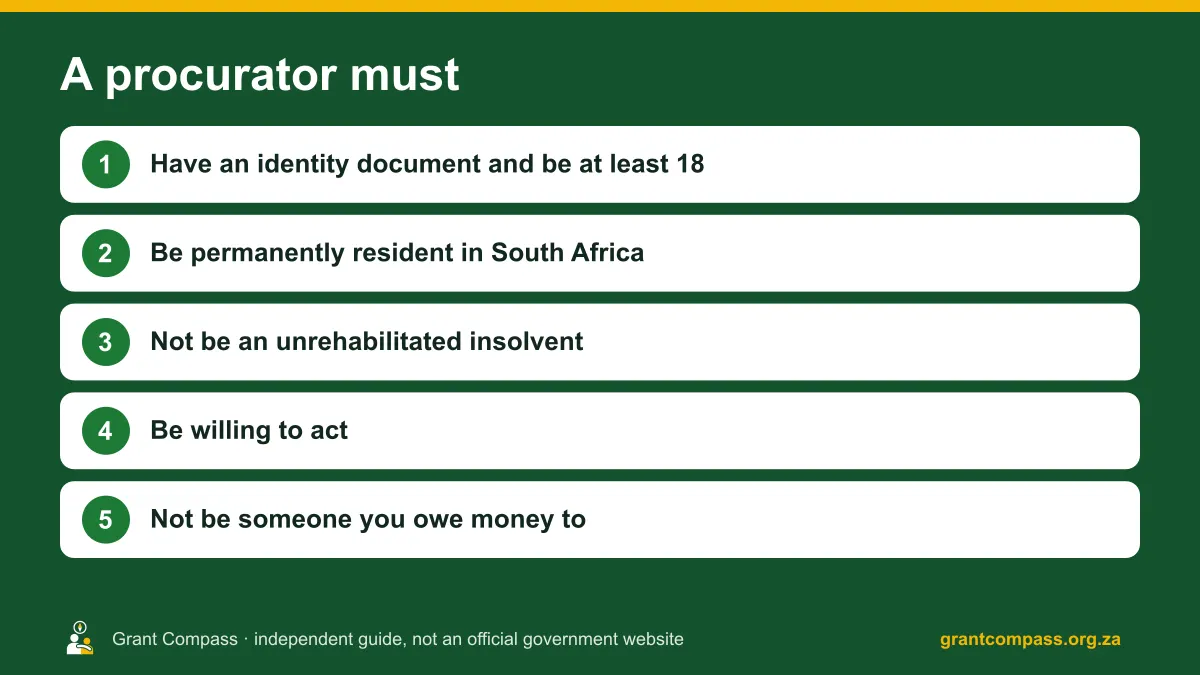
The person must meet every condition in the regulations. Family members are not exempt.
- They have an identity document.
- They are at least 18 years old.
- They are permanently resident in South Africa.
- They are not an unrehabilitated insolvent.
- They agree to act for you.
- You do not owe them money.
The debt rule matters most for many families. A lender, mashonisa or shop owner you owe may not become the person who receives your grant.
Can your child, partner or neighbour do it?
Yes, any of them can if they meet the conditions and are formally appointed. Being related does not give anyone an automatic right to collect your grant. Sharing your card and PIN is not an appointment.
How do you choose a good one?
Pick someone who is honest, lives close and can reach you on payday. Ask whether they already act for others. Choose a person who will show you proof of what they received.
What is the five-person limit?
A procurator may not receive social assistance for more than five beneficiaries. The limit is written into the regulations.
| Example | Allowed? |
|---|---|
| A daughter acts for her mother | Yes, one of five places used |
| A neighbour acts for four older people | Yes, if all appointments are valid |
| The same neighbour accepts a fifth | Yes, that reaches the limit |
| The same neighbour accepts a sixth | No |
| A relative acts for six family members | No, family has no exception |
The limit counts people. If you think someone is collecting for more than five people, report it to SASSA. Do not confront them if you feel unsafe.

Which documents do you need?
Expect a power of attorney form, both identity documents, a life certificate and an affidavit. SASSA's booklet lists the following.
| Document | What it does |
|---|---|
| SASSA power of attorney form | Records the appointment |
| Certified copy of both barcoded IDs | Identifies you and the procurator |
| Life certificate | Confirms the beneficiary is alive |
| Affidavit from the procurator | Swears the grant will be handed to you |
| Medical or social worker report | Shows need, where necessary |
| Extra affidavits | Used if you cannot sign |
The booklet says the form is signed and fingerprinted by both of you before a Commissioner of Oaths. It gives examples such as designated SASSA officials, a lawyer, a police officer or a church minister.
What if you cannot sign?
The booklet says two people who know you well may make affidavits confirming your condition. Ask your office what wording it wants before you collect signatures.
Do you pay anything?
The Act says no stamp duty is payable on this power of attorney. Do not pay anyone to "arrange" your appointment. You may have your own costs for travel, copies or a medical report.
How do you appoint a procurator?
Ask SASSA for its form first, then complete it with the person you chose.
- Talk openly with the person about what you expect.
- Visit or phone your SASSA office. The toll-free number is 0800 60 10 11.
- Ask for the procurator form and the current document list.
- Gather both IDs and certified copies.
- Get any medical or social worker report that SASSA asks for.
- Sign and fingerprint the form before a Commissioner of Oaths.
- Hand in the form, life certificate and affidavit.
- Get an acknowledgement and ask when the appointment starts.
Do not let the procurator act until SASSA confirms the appointment. You can locate a branch through SASSA offices.
What if you are bedridden?
Ask a family member to phone or visit SASSA and explain. Ask whether an official can assist at home or what other arrangement applies. We could not confirm that home visits are available in every area, so ask before you count on one.
Warning: Never hand your bank PIN to someone as part of an appointment. SASSA says beneficiaries must never share their PIN.
What if you only need help for a few months?
The regulations provide for a temporary authorisation where illness or temporary incapacity stops you from receiving the grant yourself. You complete an application for the grant to be paid to a person you authorise.
That authorisation is for a period of not more than three consecutive months. Ask SASSA for the form and for the date it ends. If your condition continues, ask about a full procurator appointment.
What may a procurator do?
A procurator may apply for or receive social assistance for you within the appointment. They must hand the money to you.
| A procurator should | A procurator must not |
|---|---|
| Bring correct documents | Keep or borrow your grant |
| Hand your money to you | Act for more than five beneficiaries |
| Report relevant changes to SASSA | Treat the grant as repayment of a debt |
| Tell SASSA when the appointment ends | Hold on to your money afterwards |
The SASSA Services Portal help page says a beneficiary and procurator can both access the grant, and that status and change notices still go to the applicant. Keep your own phone number up to date so you hear things first.
Does your procurator get your approval messages?
You should not rely on them alone. Ask your procurator to show you every letter and slip. Check your payments yourself where you can.
Do you need a procurator for a grant review?
Only if you cannot attend yourself. In March 2026, SASSA said beneficiaries who cannot visit may appoint a procurator to conduct the review, with the necessary documents and procedures.
A July 2026 statement says bedridden or medically unable beneficiaries should contact their nearest office, and may use an authorised representative where applicable.
- Phone the office as soon as the review notice arrives.
- Ask whether your current procurator may complete it.
- If you have none, ask for the appointment steps.
- Gather review papers as well as appointment papers.
- Ask the procurator to bring home proof of attendance.
Our guides explain Which review papers to pack and How to check the review status. A review notice has a deadline, so do not let the appointment delay you without telling SASSA.

Can a procurator handle the SRD grant?
We found no official procedure for appointing a procurator for the R370 SRD grant. SASSA's booklet says SRD is accessed through online application channels only.
The grant is linked to your own ID number, phone number, verification and payment details. Do not give those to a person who says they are your "SRD agent". If illness or disability stops you from managing it, ask SASSA directly what it allows.
How do you change or cancel a procurator?
You may withdraw the power of attorney and appoint someone else. The Act protects that choice.
- Tell the procurator the appointment is ending, preferably in writing.
- Notify SASSA in writing and give the effective date.
- If you cannot read or write, ask SASSA to take a sworn statement.
- Ask for any of your money to be returned.
- Start a new appointment if you still need help.
- Ask SASSA how you will be paid in the meantime.
A procurator who learns of the termination, or your plan to end it, must notify SASSA in writing at once. They must transfer any of your money they still hold within 10 days of the termination.
What if the procurator keeps your money?
Report it to SASSA immediately and end the appointment. Take proof of what should have arrived and what you received.
Call 0800 60 10 11, visit the office and consider opening a police case. Ask for a social worker if you feel pressured or unsafe. Our dedicated guide shows how to Remove a procurator who keeps your money.
Where SASSA finds a grant is being misused, it can appoint someone else to receive and manage it. The booklet calls this person an administrator. Unlike a procurator, an administrator is chosen by SASSA, not by you.
What happens if the beneficiary dies?
The procurator must stop receiving the money. Family should report the death to SASSA quickly and keep the death certificate.
Do not use the card or draw later payments. Read What to do when a grant holder passes away. A funeral cost does not give anyone permission to keep collecting.
What if SASSA refuses the appointment?
Ask for the reason and fix it. Common problems are practical ones.
- A missing paper: ask which one and bring it.
- ID copy not certified: certify it and return.
- Debt between you: choose a different person.
- Person already has five: choose someone else.
- Need not shown: ask whether a medical or social worker report would help.
- Signature problem: ask about the witness and affidavit rules.
If you still disagree or get no answer, read How to complain about SASSA service.
Are there other ways to get your money?
A bank account in your own name may reduce the need to travel to collect. It does not replace a procurator if you cannot manage your affairs.
Ask your bank about safe options for your situation. Caregivers who want to change accounts can follow our Child grant banking steps. If you need regular physical care from another person, ask about Grant-in-aid. That is extra money for you, not a procurator appointment.
Tips for a safe arrangement
- Put expectations in writing. Agree the day and time the money reaches you.
- Count it together. Check the amount against the current grant.
- Keep a payment book. Both of you sign each month.
- Keep your documents. Do not let anyone hold your ID as security.
- Keep your PIN secret. An appointment is not permission to share it.
- Ask for slips. They show amounts and dates.
- Tell a second person. A trusted relative or neighbour can notice problems.
- Review the choice yearly. Needs and relationships change.
- Report early. One short payment is worth asking about.
- Know how to end it. Written notice to SASSA is the key step.
Frequently Asked Questions
How many people can one SASSA procurator represent?
No more than five beneficiaries. The regulations set this limit for receiving social assistance on behalf of others. Relatives count too, so a person cannot exceed five by saying they are all family. Before you appoint someone, ask them directly how many people they already act for.
Can someone collect my grant with just my ID and card?
That is not a procurator appointment. Informal collection leaves you with little protection if money goes missing, and your PIN may be exposed. If you cannot manage collection yourself, ask SASSA for the formal power of attorney or, for short illness, the temporary authorisation of up to three months.
Do I need a lawyer to appoint a procurator?
No lawyer is required just for witnessing. SASSA's booklet gives several examples of a Commissioner of Oaths, including designated SASSA officials, police officers and church ministers, as well as lawyers. Ask your SASSA office who can witness locally, and do not sign the form before that person is with you.
Can my procurator be someone I owe money?
No. The regulations only allow an appointment if you are not indebted to the person. This protects you from a lender taking control of your grant to repay a loan. If someone you owe insists on holding your card or receiving the grant, report it to SASSA and the police.
Does a procurator need to be a South African citizen?
The regulation asks for permanent residence in South Africa and an identity document. It does not use the word citizen in that list of conditions. SASSA's booklet asks for certified copies of barcoded IDs, so ask your office what it accepts if the person holds a different identity document.
Can I have a new procurator next month?
Yes, you may withdraw the appointment and choose someone else. Tell SASSA in writing and give the date the old arrangement ends. The old procurator must return any money of yours within 10 days. The new person must meet the conditions and complete the paperwork before they act.
Will my grant stop if I cancel the procurator?
Ending the appointment is not the same as ending your grant. You still need a safe way to receive payment, so ask SASSA how the next payment will reach you before the date arrives. Check your account details and cellphone number at the same visit.
Can a procurator apply for a new grant for me?
Yes. The Act and regulations allow a procurator to apply for social assistance on your behalf, not only to receive it. They must complete the forms with the supporting documents. You still need to qualify, including any medical or means test for that grant. Ask for an acknowledgement of the application.
Can a procurator change my bank account?
Do not assume so. SASSA asks for an account in the beneficiary's own name and must verify changes. A procurator should not move your grant into their own account. Ask your office what a procurator may submit for you, and what proof or consent it needs.
What if my procurator moves away?
End the appointment and choose someone who can reach you reliably. Send SASSA written notice with the effective date. Ask the outgoing person to hand over any money and documents. If you have nobody else and cannot manage alone, ask SASSA about its options before the next payday arrives.
Can a procurator collect for a child grant?
A caregiver who cannot receive the grant personally can ask SASSA about appointing a procurator. This is different from changing who cares for the child. If someone else now looks after the child full time, they need to speak to SASSA about becoming the primary caregiver.
What should I do if my appointment papers are lost?
Visit SASSA with your ID and ask what is recorded on your file. Ask who is listed as procurator and when that was done. If the record shows a person you never appointed, report it at once, ask for it to be removed and open a police case.
Your next step
Phone 0800 60 10 11 or visit your office and ask for the procurator form and its current document list. Choose a person who passes every condition before anyone signs. If your need is short term, ask about the three-month authorisation instead.
Sources
- Social Assistance Act Regulations, Government Gazette 46459
- Social Assistance Act 13 of 2004, section 15
- You and Your Grant 2026 (SASSA booklet)
- SASSA urges beneficiaries to respond to 30-day notice for grant reviews, SAnews
- SASSA reminds beneficiaries identified for review to expect payment on the fourth payment day, gov.za
- Help and FAQs, SASSA Services Portal

About The Author
Michael Williams is an informational content writer focused on South African social grants, SASSA services and public assistance information.
Keep Reading