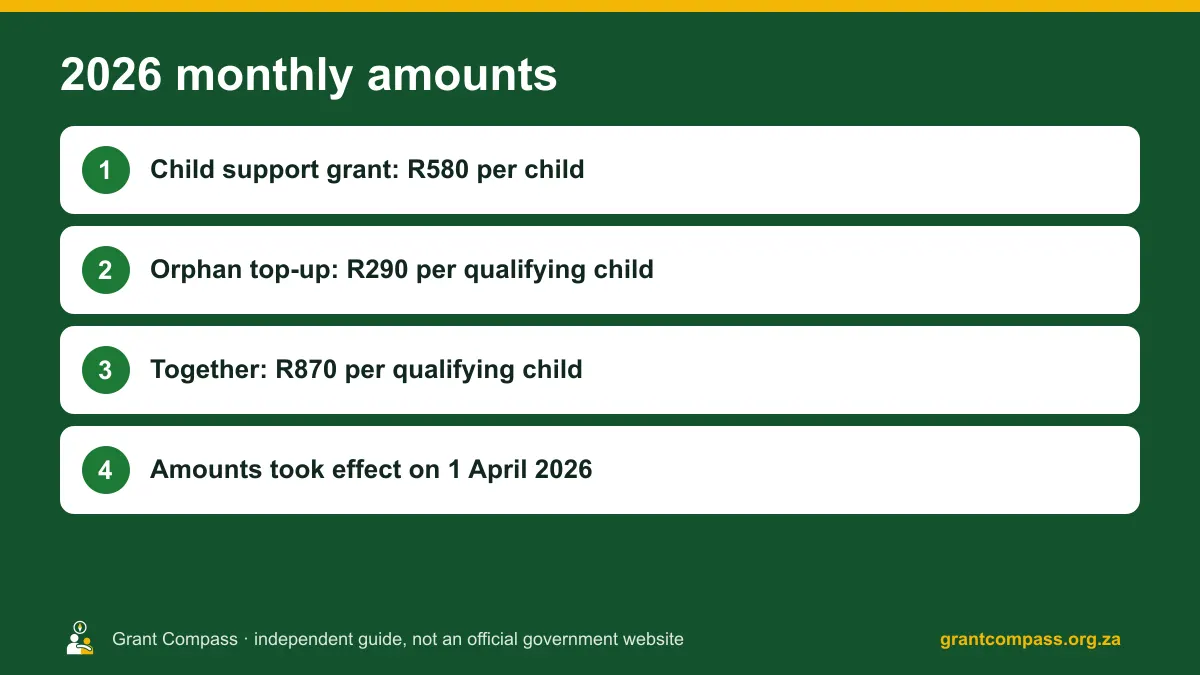
The child support grant top up is an extra R290 a month for an orphan cared for by a relative or living in a child-headed household. With the R580 grant, that makes R870 per child in 2026. You apply through SASSA, and no court order is needed.
Contents (14 topics)
- Are you caring for an orphaned child?
- How much extra will you receive?
- Who counts as an orphan and a relative?
- What other conditions apply?
- Which papers prove the child is an orphan?
- How do you apply for the top-up?
- You already get the child grant: what now?
- Can a child-headed household apply?
- How does the top-up compare with a foster child grant?
- What happens after approval?
- When can the top-up stop or be refused?
- Tips for a smoother top-up application
- Frequently Asked Questions
- Your best next step
Are you caring for an orphaned child?
If a relative's child now lives with you because the parents are gone, this extra amount may be for you. It is not a separate grant. It is added to the child support grant for that child.
The idea is to help families get support directly from SASSA. They do not first need a social worker's report and a children's court order, as foster care does.
If you do not receive any grant for the child yet, start with our Child support grant guide. You can apply for the grant and the top-up together.
How much extra will you receive?
You will receive R290 extra for each approved child, on top of R580. These maximum monthly amounts applied from 1 April 2026.
| Household example | Monthly total |
|---|---|
| One child on the grant only | R580 |
| One orphan with the top-up | R870 |
| Two orphans with the top-up | R1,740 |
| One orphan with top-up and your own child on the grant | R1,450 |
Older websites may still show R280, which was the figure before April 2026. Amounts can change with future budgets, so check the Current grant amounts before you plan.
Who counts as an orphan and a relative?
An orphan here is a child with no surviving parent caring for them. That covers a child whose parents have both died. It can also cover one dead parent where the other is not caring for the child, but proof rules still apply.
For this extra amount, a relative means a:
- grandparent
- brother or sister
- uncle or aunt
- cousin
Biological parents, adoptive parents and step-parents do not count as relatives for this purpose. A family friend or neighbour may qualify for the ordinary child grant as a primary caregiver, but not for the top-up.
What other conditions apply?
The normal child support grant rules still apply, including the means test. SASSA's 2026 booklet asks that you:
- are a South African citizen, permanent resident or recognised refugee living in South Africa
- live with the child and are the primary caregiver
- care for a child under 18 who is not permanently in a state-funded institution
- pass the means test, including a spouse's income if married
For a single caregiver the income limit works out to about R5,800 a month in 2026. A married couple's combined limit is twice that. See How the means test works.
Which papers prove the child is an orphan?
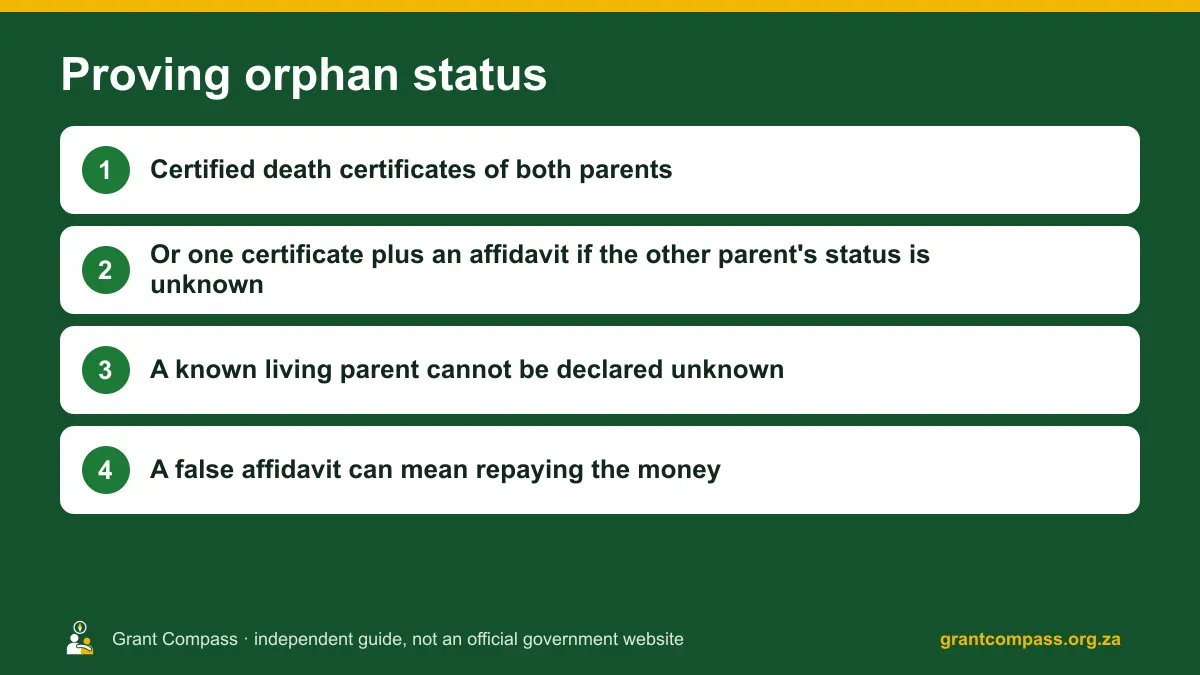
Take certified copies of both parents' death certificates. If you cannot get one of them, the regulations allow one certificate plus an affidavit saying the other parent's status is unknown.
That second option has a strict limit. If you know who the other parent is and know they are alive, the DSD practice note says the child does not qualify for the top-up. Do not sign an affidavit saying otherwise. A false statement can lead to repayment and other legal trouble.
Other documents to take
- your ID, and your spouse's ID if married
- the child's birth certificate
- proof that you care for the child, such as an affidavit, school principal's letter or social worker's letter
- proof of marital status
- recent payslip and three months of bank statements, where you have them
- your bank account confirmation or statements
SASSA may ask for more. A sworn statement about how you are related to the child is completed for the top-up.
How do you apply for the top-up?
Apply at a SASSA local office, or ask about the online route. The Department of Social Development has said that applications and tracking are also possible online.
- Check the relationship. Confirm that you are one of the listed relatives.
- Collect proof of death. Order missing certificates from Home Affairs early.
- Gather the other papers. Take originals and certified copies.
- Visit SASSA. Say clearly: "I am applying for the child support grant top-up for an orphan."
- Complete the forms. Sign the affidavit only after it has been explained to you.
- Keep your receipt. It records the date you applied.
- Follow up. SASSA must notify the outcome of an application within three months.
For help finding a branch, use our Local office guide. SASSA does not charge you to apply.
Warning: do not pay anyone to "unlock" the top-up, and never share your bank PIN.
You already get the child grant: what now?
You still need to apply for the extra amount, because the child support grant alone does not prove the child is an orphan. Take your ID, the child's birth certificate and the death certificate documents.
SASSA can find your existing record from your ID or award details. Expect to declare how you are related to the child. Do not cancel your current grant or start a second one.
If you are missing a death certificate and do not have a child grant yet, apply for the ordinary grant first. Return for the top-up once you have the proof. That way the child is not left without support while you wait.
Can a child-headed household apply?
Yes. A child aged 16 or 17 who heads a household can receive the child grant for younger siblings, plus the top-up if they are orphans. The heading child can also apply for themselves.
DSD requires a letter recognising the child-headed household. A supervising adult should help with the application. Ask the provincial social development office or a social worker to start that process.
How does the top-up compare with a foster child grant?
The foster child grant pays more but depends on a court placement. The top-up is simpler to apply for and follows child grant rules.
| Question | Child grant with top-up | Foster child grant |
|---|---|---|
| Monthly amount | R870 | R1,300 from October 2026 |
| Court order | Not needed | Needed |
| Means test | Yes | No |
| Who it is for | Relatives and child-headed households | Foster parents with a court placement |
A child already in court-ordered foster care stays in that system while the order is valid. If the child needs protection from abuse or neglect, speak to a social worker about Foster care.
What happens after approval?
SASSA pays the extra amount with the child grant and passes your details to the provincial social development department. The department can then assess whether the family needs support services or the child needs protection.
This referral is part of the rules and not an accusation. A social worker may contact you. Use the visit to ask about school, counselling or other help.
When can the top-up stop or be refused?
It ends when the child grant it is attached to ends, for example at the end of the month the child turns 18. It also depends on you remaining a qualifying caregiver.
Common trouble spots include:
- a missing death certificate or unclear affidavit
- another person already receiving a grant for the child
- income above the limit
- a caregiver who is not a listed relative
- different names or ID numbers across documents
If you are declined, ask for the reasons in writing. You have 90 days from learning of the decision to ask SASSA to reconsider. You then have 90 days to appeal a reconsidered decision you disagree with. Read When the child grant stops for other endings.
Tips for a smoother top-up application
- Order certificates early. Home Affairs paperwork can take time, so start before your SASSA visit.
- Bring the family tree. A short written note of how you are related helps you complete the affidavit.
- Tell the truth about parents. Say what you know and what you do not know.
- Ask a school for a letter. A principal can confirm that the child lives in your care.
- Do not delay the basic grant. Apply for it even if a top-up paper is still outstanding.
- Check names carefully. Spelling differences between certificates can stall a file.
- Keep one folder. Store receipts, certificates and notices together for later reviews.
- Report changes. Tell SASSA if the child moves or a surviving parent resumes care.
Frequently Asked Questions
What is the child support grant top up?
It is an additional monthly amount linked to the child support grant for orphans in the care of relatives or in child-headed households. It is not a stand-alone grant. The child grant rules and means test still apply, and the extra money is paid per approved child through SASSA.
How much is the orphan top-up in 2026?
The top-up is R290 a month from 1 April 2026. Added to the R580 child support grant, the total is R870 for each qualifying child. These are maximum monthly amounts published by notice in the Government Gazette. Check again after the next national Budget, because the figures can change.
Do I need a court order?
No. Relatives can apply directly at SASSA without a social worker's investigation, report or court order. Court orders belong to foster care. If a social worker is worried about the child's safety or care, a separate child protection process may still be needed, which is not the same application.
Can I get the top-up if only one parent died?
Possibly, in a narrow case. The proof route allows one death certificate plus an affidavit when you do not know the status of the other parent. If you know the other parent is alive, the child does not qualify for the top-up. Explain your facts honestly to SASSA.
Can a grandmother apply?
Yes. A grandparent is one of the listed relatives. She must care for the child, live with them, pass the means test and prove that the child is an orphan. Her relationship to the child is stated in a sworn statement, and SASSA may ask for further proof.
Can a step-parent or adoptive parent apply?
Not for the top-up. Step-parents, adoptive parents with a court order and biological parents are not treated as relatives for this extra amount. They may still be able to receive the ordinary child support grant if they are the primary caregiver and meet its other requirements.
Do I lose my current child grant while SASSA checks the top-up?
Applying for the extra amount is not a cancellation of your existing child support grant. The ordinary grant continues on its own rules while the top-up is considered. Keep your receipt, answer any requests for documents and check your payment amount once SASSA tells you the outcome.
Is the top-up backdated?
For social grants, payment usually starts from the date of application, when the required documents were accepted. We found nothing that pays the top-up for months before you applied. That is a good reason to apply soon. Ask the SASSA official which date appears on your receipt.
Does the top-up count for my own children?
No. It applies only to orphans who meet the proof rules and are cared for by a relative or live in a child-headed household. Your own biological children can qualify for the ordinary child support grant. Each child on your record is assessed separately.
What if my application is rejected?
Ask for the written reason first. Then fix any missing proof or ask SASSA to reconsider within 90 days. If the reconsidered decision still goes against you, you may appeal within 90 days. A social worker, legal advice office or SASSA official can help you prepare.
Your best next step
Get the parents' death certificates together, then visit SASSA and ask for the orphan top-up by name. If one certificate is missing, still ask which option fits your facts. Phone 0800 60 10 11 if you need directions first.
Sources
- Social Assistance Regulations, 2022 (Government Gazette 46459)
- Increase in respect of social grants, 2026 (Government Gazette 54397)
- DSD: social grants process improved to benefit orphaned children
- DSD practice note on the CSG top-up
- SASSA grant booklet 2026 (You and Your Grant)

About The Author
Michael Williams is an informational content writer focused on South African social grants, SASSA services and public assistance information.
Keep Reading