SASSA proof of life, also named life certification, is how you show that you are living and may keep being paid. The online option is e-Life, found on the services portal. If a record says you have died when you have not, start at Home Affairs and carry its proof to SASSA.
Contents (16 topics)
- Which problem are you facing?
- Why does SASSA ask you to prove you are alive?
- Who must complete life certification?
- How do you complete e-Life Certification online?
- Why does e-Life fail or not load?
- What if you cannot do it online?
- What happens if you do not certify?
- What does a deceased error mean?
- How do you fix a wrong deceased record?
- What should you take to Home Affairs?
- What happens with SASSA after the correction?
- What if someone is using your ID?
- What should you check before you close the page?
- Tips for keeping your grant safe
- Frequently Asked Questions
- Your best next step
Which problem are you facing?
Match your situation to the right section before you start, because the fixes are very different.
| What is happening | What it likely means | Start here |
|---|---|---|
| SASSA asked you to certify | A deadline applies to you | The e-Life steps |
| The portal or face check fails | Technical or matching problem | The troubleshooting section |
| Status or payment says deceased | A record shows you have died | Home Affairs |
| Grant stopped after no certification | Possible suspension | Restoring your grant |
Why does SASSA ask you to prove you are alive?
The law behind social grants asks for it. By checking that each recipient is living, SASSA tries to block money going to invented people or to those who have passed on.
e-Life Certification lets you do this from a phone or computer. A face check shows it is really you, which can save you taxi fare and hours in a line.
Who must complete life certification?
If you can manage the portal, SASSA asks you to do it yearly. If SASSA singles you out with a request, the date on that request is binding.
Your age and the kind of grant do not excuse you from such a request. Read the notice slowly and circle the closing date. If you are unsure whether a message is real, phone 0800 60 10 11 before doing anything.
SRD applicants have their own identity checks. See Face scan help if your request is on the SRD portal.
How do you complete e-Life Certification online?
Use the official SASSA online services portal on a device with a camera.
- Go to https://services.sassa.gov.za/portal/r/sassa/sassa/home.
- Register or sign in as the page directs.
- Open the e-Life Certification section.
- Check that your personal details are correct.
- Complete the identity check, including the face scan.
- Follow every prompt until you see confirmation.
- Save a screenshot with the date.
- Sign out, especially on a borrowed device.
The beneficiary must do their own check. Do not give your login, code or ID photos to someone who offers to certify for you.
What you need: your ID document, your own cellphone number, a stable connection and a working camera.
Why does e-Life fail or not load?
The usual causes are system faults, weak connections, camera problems or a face that does not match the record. SASSA itself reported portal glitches in April 2026 and said they were resolved, so faults do happen.
| Symptom | What to try |
|---|---|
| Page will not open | Wait, then try later or use another browser |
| No one-time pin | Check signal and the number on record, then request once more |
| Camera blocked | Allow camera access in your browser settings |
| Face check fails | Use even light, remove hats, hold the phone steady |
| Details look wrong | Do not certify over errors; ask SASSA to correct them |
| Session times out | Prepare documents first and finish in one sitting |
For missing codes, our OTP fixes may help. Site problems are covered in Website not loading.
What if you cannot do it online?
Contact or visit your nearest SASSA office and ask how to complete life certification in person. SASSA's own advice is to ask the office about access to the service.
Take your ID, any notice you received and your phone. If you cannot travel because of age or illness, phone first and ask about your options. A family member can ask what is needed, but cannot simply certify in your place.
Find an office through our Local offices guide. If someone collects your grant for you, read about Procurators, since a life certificate forms part of those arrangements.
What happens if you do not certify?
You risk a late or frozen payment, SASSA has cautioned. Saying nothing can also leave the agency thinking the recipient is dead or the claim is false.
If your grant has been suspended, act quickly. SASSA's 2026 booklet says that where a grant is suspended for not completing a review, you must apply for restoration within 30 days of suspension. Ask the office whether that applies to your case.
Read Getting a stopped grant back for the restoration route, and Preparing for a review if a review notice arrived too.
What does a deceased error mean?
It means a record linked to your ID number shows that you have died. SASSA compares its beneficiary details with Home Affairs records and stops payment where a death is shown.
If you are reading this about yourself, something is wrong. Possible causes include a capturing error, a mix-up between ID numbers, or someone fraudulently registering a death. Only an investigation can tell which one applies.
If the person has in fact died, see Reporting the death of a beneficiary.
How do you fix a wrong deceased record?
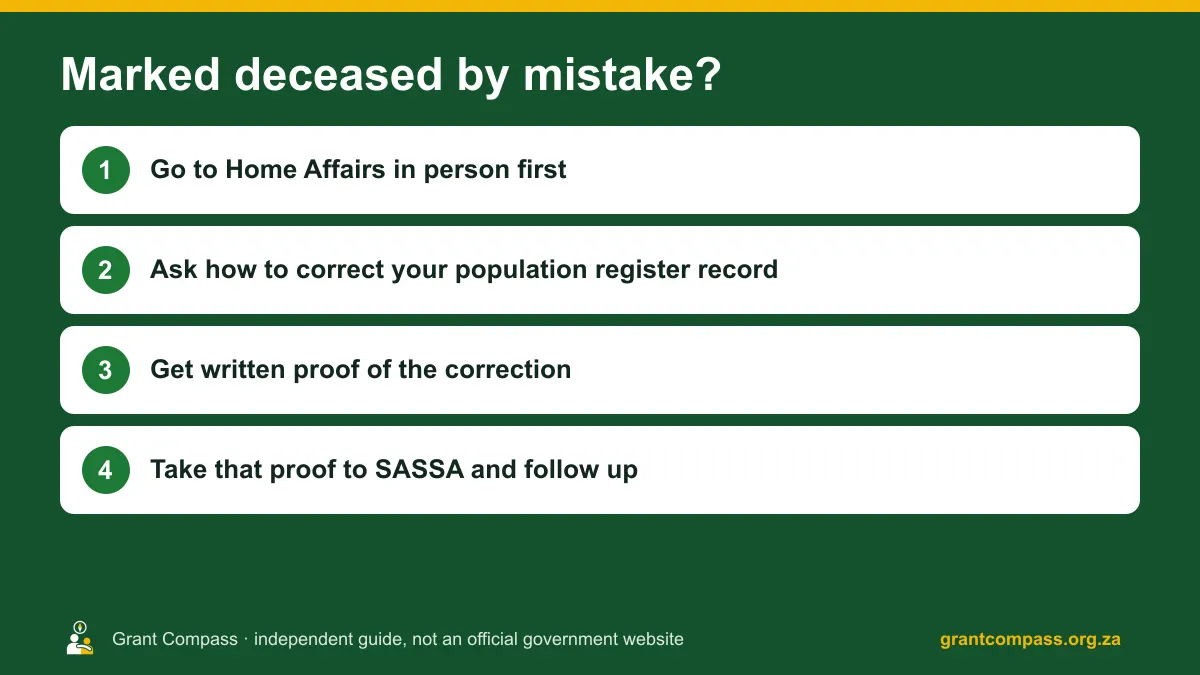
Correct the population register at Home Affairs, then return to SASSA with proof. SASSA cannot declare you alive on Home Affairs' behalf.
- Screenshot or write down the SASSA message and date.
- Go to a Home Affairs office in person.
- Take your ID and any other identity documents.
- Explain that you are recorded as deceased.
- Ask whether you need a police affidavit confirming you are alive.
- Provide fingerprints and complete any forms requested.
- Ask for a reference number and an expected timeline.
- Follow up until the record is corrected.
- Get written confirmation of the correction.
- Take it to SASSA.
Home Affairs described an affidavit and fingerprint process in 2009. Current requirements may differ, so confirm them at the office.
What should you take to Home Affairs?
Take everything that shows who you are and that the record is wrong.
| Item | Why it helps |
|---|---|
| ID card or ID book | Links you to the ID number |
| Birth certificate, if you have it | Supports your identity |
| Police affidavit, if requested | States that you are alive |
| SASSA message or letter | Shows the problem you found |
| Bank or clinic letters, if available | Extra supporting proof |
Keep originals with you unless an official gives a receipt for them.
What happens with SASSA after the correction?
Ask SASSA to update your file and tell you what is needed to restart payment. For an SRD month declined as deceased, appeal that month, generally within 90 days.
For a permanent grant, ask the office whether you need restoration, a new application or an appeal. Ask specifically about the months you missed. We could not confirm a general promise of back pay, so get the answer for your own case. SRD applicants can read How to appeal.
How long does it take?
No fixed period is guaranteed. A Home Affairs investigation can take weeks or longer, especially if fraud is involved. Follow up regularly and keep your reference number.
What if someone is using your ID?
Report it to Home Affairs, SASSA and the police. A false death record or unknown activity can point to identity fraud.
The SASSA fraud line is 0800 701 701. Ask your bank to check for accounts you did not open. Keep a case number and copies of everything you submit.
What should you check before you close the page?
Make sure the process ended with a clear confirmation, not just a closed screen. Check that your name and ID details were correct, and save the date. If you saw no confirmation, treat the certification as unfinished. Sign in again later or ask a SASSA office whether it was received.
Tips for keeping your grant safe
These habits reduce the risk of a stopped payment.
- Certify early. Do not wait for the final day of a notice. Systems can fail when you need them.
- Set a yearly reminder. SASSA encourages annual certification. Pick a date you will remember.
- Keep your number current. Notices and codes go to it. Tell SASSA when it changes.
- Save proof. Screenshot confirmations and keep reference numbers. They help if payment stops.
- Check payments monthly. A missed payment is an early warning. Ask about it straight away.
- Use your own device if possible. Borrowed phones can keep your pictures and logins.
- Open official letters. Review notices carry deadlines. Ask someone trusted to read them with you.
- Guard your documents. A lost ID can be misused. Report and replace it.
- Refuse paid shortcuts. Certification does not require an agent. Do not pay strangers.
Frequently Asked Questions
What is SASSA proof of life?
It is the yearly style of check, called life certification, that shows a person on a grant is still living. Social assistance law requires it. The e-Life route works from a phone or computer with a face check. When a request arrives with your name on it, answer before its closing date.
How do I do SASSA e-Life certification?
Go to the SASSA online services portal, sign in, check your details and complete the e-Life biometric check. You need your ID, a phone number, internet access and a camera. Follow the prompts until you get confirmation. Save a screenshot and sign out when you finish.
How often must I submit proof of life?
Once a year is what SASSA asks of people able to use the online service. A direct request from the agency overrides your usual date, so follow the deadline printed there, even after an earlier certification. Check with SASSA on 0800 60 10 11 if you are unsure about your date.
Why is my e-Life certification failing?
Common causes are portal faults, poor internet, blocked camera access, bad lighting or a face that does not match stored records. Improve your setup and try again later. If it keeps failing, contact your nearest SASSA office with your ID and ask for another way to certify.
Will my grant stop if I do not certify?
Yes, that can happen, as a delay or a suspension. The agency has also cautioned that no response might be taken to mean the recipient has died or is not real. Act on any notice quickly. If payment has already stopped, visit an office and ask about restoration and its deadline.
Can a family member certify for me?
The check is meant to confirm that the beneficiary is alive, using their own identity and face. A relative can help you read the screen or travel to an office. If you cannot do it because of illness or disability, ask SASSA about the correct arrangement for your situation.
Why does SASSA say I am deceased?
A record linked to your ID number shows a death, often seen through SASSA's matching with Home Affairs data. It could be an error, a mix-up or fraud. Visit Home Affairs to investigate and correct the record. Then bring written proof to SASSA to update your grant.
Can SASSA change my deceased status?
The population register belongs to Home Affairs, so the correction must start there. SASSA can then act on the corrected information. Calling SASSA alone is unlikely to fix a Home Affairs record. Ask both offices for reference numbers and follow up until your file shows the right position.
Will I get back the payments I missed?
We could not confirm a general rule, so do not count on it until SASSA confirms your case. Ask which months are affected, what you must submit and any deadlines. For SRD months declined in error, lodge an appeal for each month within the permitted period.
Where can I report grant fraud?
Call the SASSA fraud line on 0800 701 701, or the toll-free number 0800 60 10 11. You can also email [email protected]. If someone used your identity, report it to the police and Home Affairs too. Keep copies of messages and note your case number.
Your best next step
If you have a certification notice, complete e-Life today or visit an office before the deadline. If you are shown as deceased, go to Home Affairs first. Then confirm with SASSA, and check What changes you should report so your record stays accurate.
Sources
- SAnews: SASSA beneficiaries urged to use e-Life Certification portal
- Vuk'uzenzele: How to complete your SASSA e-Life Certification online
- You and Your Grant (SASSA booklet 2026)
- Home Affairs alive status verification service (2009)

About The Author
Michael Williams is an informational content writer focused on South African social grants, SASSA services and public assistance information.
Keep Reading