A SASSA status declined result means your SRD application was refused for the month shown, and a reason should appear with it. Find that reason first. Then correct any wrong record and appeal each declined month, generally within 90 days of the decision.

Contents (18 topics)
- If your screen says Declined, what should you do first?
- What does SASSA status declined really mean?
- Which rules must you meet for the SRD grant?
- What do the common decline reasons mean?
- Declined for alternative income: what can you do?
- Declined for UIF registered: is it final?
- Declined for NSFAS registered: what proof helps?
- Declined for identity or deceased records: how do you fix it?
- What if the reason is a duplicate or another grant?
- How do you appeal a declined SRD month?
- What happens after you appeal?
- Why did an approved status change to declined?
- How do you write an appeal that is easy to follow?
- What can you do if you cannot appeal online?
- How do the months fit together while you wait?
- Tips to avoid another refusal
- Frequently Asked Questions
- Your best next step
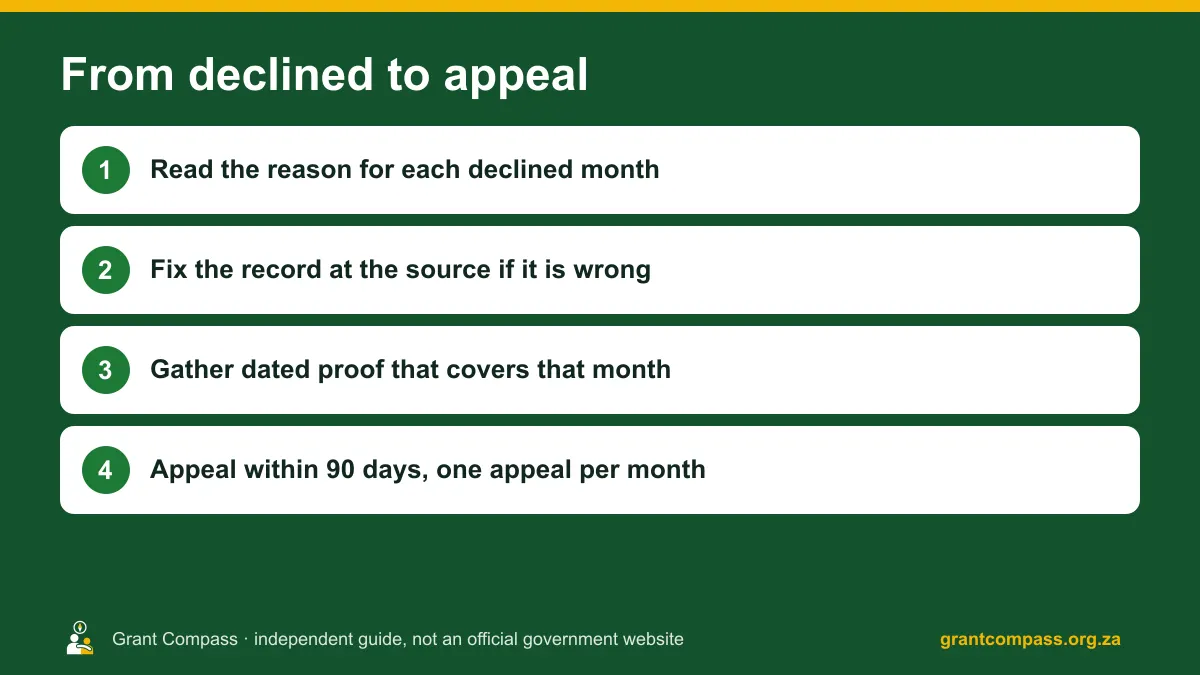
If your screen says Declined, what should you do first?
Stop and read the whole result before you change anything. The reason beside the month decides your next move.
- Open https://srd.sassa.gov.za and check your status.
- Write down every month marked Declined.
- Copy the reason for each month word for word.
- Take a screenshot that shows the month and reason.
- Note the date you first saw the refusal.
- Decide whether the reason is true, outdated or wrong.
That last step matters most. A true reason cannot be argued away, but a wrong or outdated one can be challenged.
Do not create a second application to get around a refusal. It does not erase the first decision and can create new problems.
If you cannot get into the system, try the other routes in our SRD status check guide.
What does SASSA status declined really mean?
It means SASSA assessed that month and decided you did not meet a rule. It does not automatically cancel every month.
The grant is checked again for each month. You can be refused for September and approved for October if your records change. You can also be approved first and refused later.
A refusal is also different from a technical delay. A pending month has no decision yet. A payment problem happens after approval. See Pending status explained if you are not sure which you have.
Which rules must you meet for the SRD grant?
You must meet all the basic rules in the month being checked. SASSA's 2026 booklet lists them.
| Rule | What it asks of you |
|---|---|
| Status in South Africa | Citizen, permanent resident, refugee, certain special permit holder, or asylum seeker with a valid Section 22 permit or visa |
| Records | Registered on the Home Affairs database |
| Age | 18 or older and under 60 |
| Residence | Living inside South Africa |
| Care | Not looked after in a state-funded institution |
| Work and study | Not unreasonably refusing a job or education opportunity |
| Means | Passing the means test |
| Other grants | Not receiving another social grant for yourself |
Receiving a child support grant for your child is a grant for the child. If your own refusal mentions another grant, check which grant is recorded in your name.
What do the common decline reasons mean?
Each reason points to one record or rule, so match your wording to the closest line. Exact phrases can differ and may change.
| Reason you may see | What it points to | First thing to check |
|---|---|---|
| Alternative income source identified | Records show money coming to you | Your bank statements for that month |
| UIF registered | UIF records are linked to you | Your position with the UIF |
| NSFAS registered | Student funding records are linked to you | Your NSFAS funding status |
| Identity verification failed | Your details could not be confirmed | Your Home Affairs details and face check |
| Existing grant | A social grant is recorded in your name | Which grant it is |
| Recorded as deceased | A record shows you have died | Home Affairs, urgently |
| Age | Your age falls outside the limits | Your ID date of birth |
Declined for alternative income: what can you do?
Check what actually entered your accounts in that month, then decide whether it was really your income. SASSA says it checks outside sources, including banks.
The threshold has been R624 a month. In January 2025 the Pretoria High Court found several SRD rules unconstitutional, including that threshold. The government appealed. The Supreme Court of Appeal heard the case in August 2026 and, as far as we could confirm, had not yet ruled. Check for newer news before relying on this.
- Get statements for every bank account in your name.
- Mark each deposit for the declined month.
- Write next to each one who sent it and why.
- Separate pay from gifts, loans, refunds and your own transfers.
- Collect proof for the amounts that were not your earnings.
- Appeal that month with a short, factual explanation.
Our guide to SRD money checks explains deposits, wallets and transfers in detail.
What if the money was not yours?
Explain it and show the trail. For example, money held for a relative should be shown arriving and leaving. A note from the sender helps, but bank records carry more weight. Be honest, because false information can cause worse trouble than a refusal.

Declined for UIF registered: is it final?
No, a UIF reason can be checked and challenged if the record is wrong or out of date. Being listed on UIF records is not the same as being paid benefits today.
Confirm your position with the UIF before you appeal. Ask whether a claim is active, whether money is still due, and whether an employer still shows you as working. Get the answer in writing if you can.
We cover this fully in Declined for UIF registration.
Declined for NSFAS registered: what proof helps?
Proof from NSFAS about your actual funding position helps most. A record can linger after you stop studying or stop receiving support.
- Log in to your myNSFAS account and check the funding status.
- Contact NSFAS on 08000 67327 if the status is wrong.
- Ask for written confirmation with dates.
- Add any proof from your college or university that you have left.
- Appeal each declined month with these documents.
If you are still funded and receiving allowances, an appeal is unlikely to change the result. Read the NSFAS status check guide to understand your record.
Declined for identity or deceased records: how do you fix it?
Fix the identity record before you rely on an appeal. SASSA matches you against Home Affairs data.
For an identity failure, compare your name, surname, ID number and date of birth with your ID document. Complete the facial check if the portal asks for it. Our Face scan help covers repeat failures.
If the screen says you are deceased, go to Home Affairs first. Only Home Affairs can correct the population register. The steps are in our guide to Proof of life and deceased errors.
What if the reason is a duplicate or another grant?
Ask SASSA to show you which record is causing the conflict. These reasons are hard to solve from your side alone.
If a message mentions a duplicate application, do not apply again. Call 0800 60 10 11 or visit an office with your ID. Tell them if a number was shared or someone may have used your details.
If a grant you do not know about is recorded in your name, ask for the details in writing. Report suspected fraud on 0800 701 701. If you now receive another grant for yourself, the SRD refusal is likely correct.

How do you appeal a declined SRD month?
You appeal online, for one declined month at a time. The appeal is considered by the Independent Tribunal for Social Assistance Appeals, which is separate from SASSA.
- Go to https://srd.sassa.gov.za/appeals, or the department's page at https://srd.dsd.gov.za.
- Enter your ID number and the cellphone number on your application.
- Type in the code sent to that phone.
- Choose the month you want to challenge.
- Select the reason that matches your refusal.
- Explain briefly why the decision is wrong.
- Upload proof if the form lets you.
- Submit, then save the confirmation.
- Repeat for every other declined month.
The pages may look different when you visit, so follow the instructions on screen. If the portal offers a reconsideration step, read what it says about that choice. Our Appeal walkthrough goes through it slowly.
How long do you have to appeal?
Appeal within 90 days of the decision. Older official guidance describes a window of at least 30 days and not more than 90 days. Do not wait for the last week. If you have missed it, ask whether late appeals can be accepted with good reasons.
Which documents should you gather?
Collect proof that is dated and covers the month in question.
| Your reason | Useful proof |
|---|---|
| Income | Statements for all your accounts, plus notes on each deposit |
| UIF | Written UIF confirmation of your benefit position |
| NSFAS | NSFAS or institution letter with dates |
| Identity | Clear copy of your ID and any Home Affairs confirmation |
| Deceased | Home Affairs proof that your record is corrected |
What happens after you appeal?
The tribunal reviews the month and tells you the outcome electronically. Official guidance has spoken of 60 to 90 days, but delays can happen.
Check progress on the appeals page using the same ID and phone number. Read How to check your appeal outcome so you understand each result. A successful appeal changes that month only. Keep checking your newer months too.
An appeal that fails is usually the end of the internal route. A court review is possible, but get legal advice first. Legal advice offices and civil society groups may help for free.
Why did an approved status change to declined?
Because a later check found something new for a later month, or a check flagged your records. Approval for one month never fixes the next.
Common triggers include a new deposit, a new UIF or student funding record, or a change in your details. Look at the month on each result. If an approved month suddenly shows as unpaid or cancelled, read Cancelled status reasons.
How do you write an appeal that is easy to follow?
Write a short, dated and factual explanation that answers the refusal reason directly. The person reading it does not know your story.
Use this order:
- Name the month you are appealing.
- Quote the reason shown.
- Say why it is wrong or out of date.
- Give the key date or amount.
- List what you attached.
For example: "October was declined for NSFAS registered. I stopped studying before that month. I attached the letter showing the date." Use your own true facts, never a copied story.
Avoid long accounts of hardship that do not touch the reason. They are understandable, but the question is whether you met the rules in that month. Stay calm and polite.
What weakens an appeal?
Some mistakes are easy to avoid.
| Weak point | Better approach |
|---|---|
| Wrong month chosen | Compare with your screenshot before you submit |
| Wrong reason selected | Pick the one closest to the screen wording |
| Statements from one account only | Include every account in your name |
| Undated letter | Ask for dates covering the month |
| Blurry photo | Retake it flat, in daylight |
| One appeal for many months | Submit for each declined month |
What can you do if you cannot appeal online?
Ask for help at a SASSA office or call the toll-free line. SASSA's 2026 booklet says you can request assistance from a SASSA official to lodge an appeal.
Take your ID, your phone with the registered number and your proof. A trusted relative can help you read the screens. Keep your code private until you type it yourself.
If the website is down, note the date and screenshot the error. Try again later, and do not leave it until the final days. Our guide to SASSA contact options lists ways to reach the agency.
What if you no longer have your registered number?
You need that number for the code, so sort it out early. Follow the official process to Update your cellphone number. Ask SASSA what to do about an appeal deadline while the change is pending.
How do the months fit together while you wait?
Treat each month as its own file, with its own result and deadline. An appeal for one month does not pause checks on the next.
Keep a simple table in a notebook:
- the month;
- the result and reason;
- the date you saw it;
- the date you appealed;
- the outcome.
If newer months show the same reason, appeal those too. Fix the underlying record in the meantime, or the refusal is likely to repeat. If the reason changes, deal with the new one on its own terms.
Tips to avoid another refusal
Small habits protect future months.
- Check every month. Refusals are easy to miss. Look at your status regularly so the 90 days do not slip past.
- Keep one proof folder. Store statements, letters and screenshots together. You will not need to search under pressure.
- Know your deposits. Note who sends you money and why. A two-line note today saves a hard memory test later.
- Do not lend your account. Money passing through can look like yours. Politely ask people to use their own accounts.
- Update records at the source. SASSA reads other databases. Correct UIF, NSFAS or Home Affairs errors with those bodies.
- Tell the truth. Declare real changes in your situation. False claims can lead to repayment or worse.
- Protect your number. Codes and links arrive on it. Replace a lost SIM and update SASSA properly.
- Avoid paid fixers. Appeals cost nothing to lodge. Anyone selling a guaranteed approval is misleading you.
- Write down dates. Record when you appealed and what you attached. It helps when you follow up.
Frequently Asked Questions
Why is my SASSA status declined?
Your status is declined because a check for that month found you did not meet a rule, or a record suggested so. The reason beside the month tells you which one. Common examples are alternative income, UIF, NSFAS or identity problems. Read that reason before choosing a fix.
How do I fix a declined SASSA status?
Find the reason, check whether it is true, correct any wrong record and appeal that month. Gather dated proof first. Fix UIF, NSFAS or Home Affairs errors with those bodies, because SASSA relies on their data. Then follow the online appeal steps and save your confirmation.
How long do I have to appeal a declined SRD grant?
You generally have 90 days from the decision to lodge an appeal. Each declined month has its own decision, so it needs its own appeal. Do not wait until the deadline is close, because codes, websites and documents can all cause delays. Check the portal for current rules.
Can I appeal more than one month at once?
Appeals are made month by month, so plan to submit one for every declined month you disagree with. The proof may be similar, but check that it covers each month. Keep a list showing the month, date submitted and documents used, so nothing gets missed.
Should I reapply after being declined?
Do not send a new application just to replace a refusal. The SRD system checks eligibility monthly, and an appeal is the way to challenge a past month. Follow any reapplication instruction the portal shows you. If you are unsure, ask SASSA on 0800 60 10 11 first.
Does declined mean my grant is cancelled forever?
No, a declined result applies to the month shown. A later month can be approved if you meet the rules and records are correct. If a lasting problem remains, such as another grant or a wrong record, later months may also be refused until it is resolved.
Why was I declined when I have no job?
Being unemployed is not the only test. SASSA also checks money entering your accounts, UIF and student funding records, identity and other grants. A deposit from family, an old record or a data error can lead to refusal. Check the reason and your records, then appeal with proof.
What proof do I need for an SRD appeal?
Use documents that answer your specific reason. Bank statements help with income reasons, a UIF or NSFAS letter helps with those records, and Home Affairs proof helps with identity errors. Make copies clear, dated and readable. Keep your originals and never send your bank PIN or card numbers.
Where do I get help with a declined status?
Call SASSA toll-free on 0800 60 10 11, email [email protected] or visit a local office. The SRD WhatsApp line is 082 046 8553. Take your ID, the declined month and the reason. Free community advice offices may also help you prepare an appeal.
Will I get back pay if my appeal succeeds?
A successful appeal can lead to payment for the month that was approved on appeal. Payment is not instant, because it still has to be processed. Keep your banking details correct and check the portal. Our back pay guide explains what to watch for and when to ask.
Your best next step
Write down each declined month with its exact reason, then start the oldest appeal first, so no deadline passes. If you are waiting for money from a month that later succeeds, our guide to Missed SRD months and back pay shows what to check.
Sources
- You and Your Grant (SASSA booklet 2026)
- SRD appeals information
- SASSA statement on declines and biometric verification
- GroundUp: Rules regulating SRD grant are unconstitutional, court finds
- GroundUp: Decision on basic income support delayed until court ruling

About The Author
Michael Williams is an informational content writer focused on South African social grants, SASSA services and public assistance information.
Keep Reading